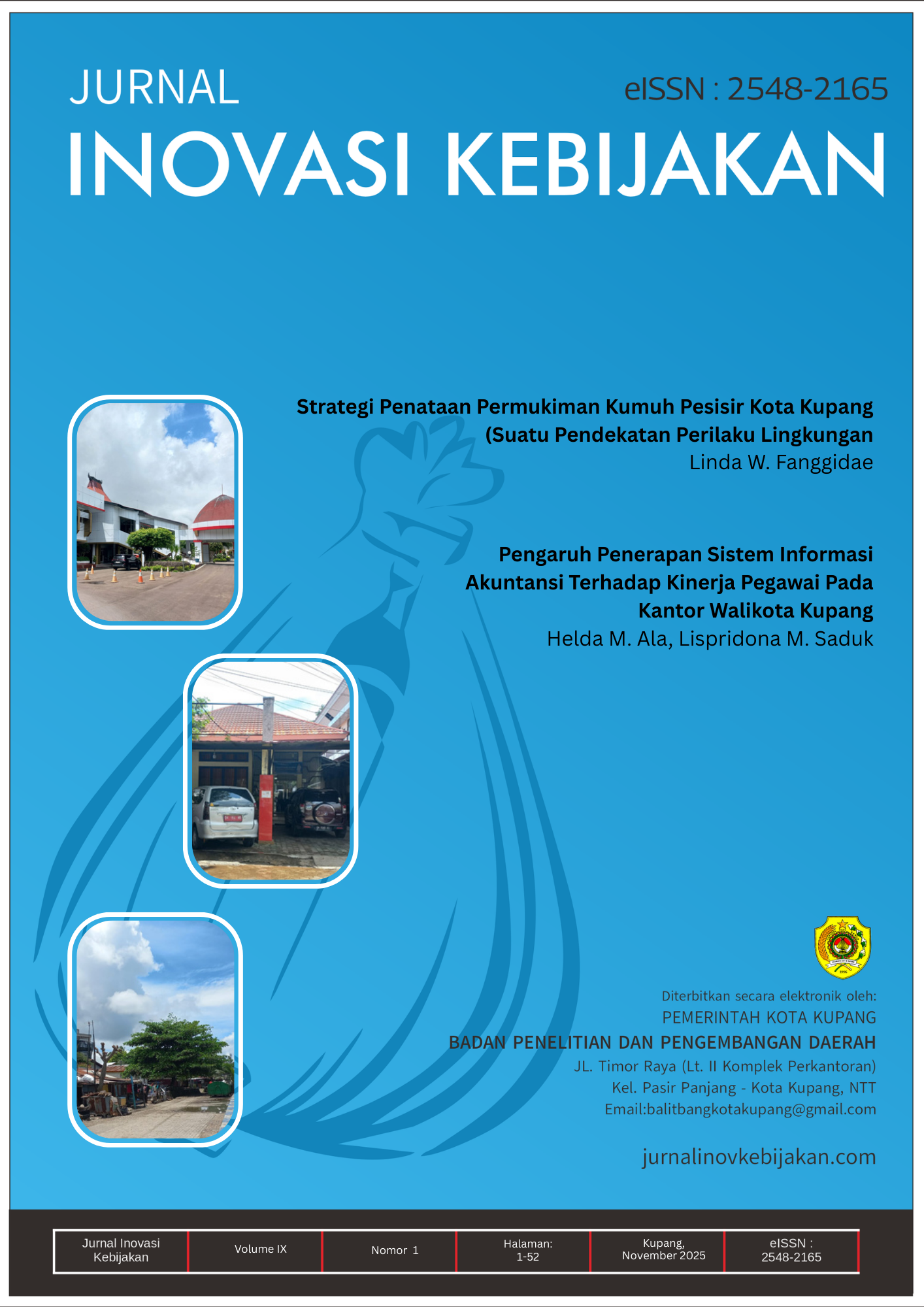
The Effect of Accounting Information System Implementation on Employee Performance at the Kupang City Government Office
DOI:
https://doi.org/10.37182/ntfrgt11Keywords:
Accounting Information System, Employee Performance, Local GovernmentAbstract
The purpose of this study is to analyze The Effect of The Implementation of An Accounting Information System on Employee Performance at the Kupang Mayor's Office. The independent variables studied were the Utilization of The Accounting Information System, The Quality of The Accounting Information System, and The Security of the Accounting Information System, while the dependent variable was Employee Performance. This study was conducted at Regional Work Units (SKPD) within the Kupang City Government with 30 Respondents. Data were obtained through the distribution of questionnaires completed directly by the respondents. Data analysis used the following methods: classical assumption test, multiple linear regression analysis, t-test, F-test, and coefficient of determination using SPSS version 16 software. The results indicate that The Utilization of The Accounting Information System, The Quality of The Accounting Information System, and The Security of The Accounting Information System have a positive and significant effect on employee performance. This study is expected to serve as a reference for further research and provide recommendations for government agencies to improve employee performance through the optimal implementation of an Accounting Information System.
Downloads
References
Anggraini, O. (2018). Pengaruh sistem informasi akuntansi terhadap kinerja pegawai kantor Kecamatan Tegalsari Kota Surabaya.
Dimas, A. W., & Priono, H. (2022). Pengaruh sistem informasi akuntansi dan sistem pengendalian internal terhadap kinerja karyawan.
Fahmi. (2016). Kinerja adalah hasil yang diperoleh suatu organisasi, baik yang bersifat profit oriented maupun non profit oriented, yang dihasilkan selama satu periode waktu.
Ghozali, I. (2011). Aplikasi analisis multivariate dengan program SPSS. Semarang: Badan Penerbit Universitas Diponegoro.
Hayunda, R. (2022). Pengaruh penerapan sistem informasi akuntansi, kualitas sistem informasi akuntansi, dan kesesuaian tugas teknologi terhadap kinerja pegawai.
Indralesmana, K. W., & Suaryana, I. G. N. A. (2014). Penerapan sistem informasi akuntansi dan kinerja individu pada usaha kecil dan menengah di Nusa Penida. Jurnal Akuntansi, 7(2), 1–10.
Kristiani, W. (2011). Analisis pengaruh efektivitas teknologi sistem informasi akuntansi terhadap kinerja individual pegawai PT Kim Eng Sekuritas Indonesia. Jurnal Akuntansi. Universitas Gunadarma, Jakarta.
Krismiaji. (2015). Sistem informasi akuntansi. Yogyakarta: UPP STIM YKPN.
Perdanawati. (2014). Pengaruh unsur-unsur kepuasan pengguna—kelengkapan fungsi, stabilitas, kemudahan penggunaan, inovasi, keamanan, dan fleksibilitas—terhadap efisiensi dan efektivitas kerja pengguna aplikasi sistem informasi akuntansi.
Pemerintah Republik Indonesia. (2010). Peraturan Pemerintah Nomor 71 Tahun 2010 tentang Standar Akuntansi Pemerintahan. Jakarta: Sekretariat Negara.
Purwaningsih. (2010). Analisis pengaruh kualitas sistem, kualitas informasi, dan kualitas pelayanan terhadap kepuasan pengguna sistem informasi akuntansi.
Putri, V. R., & Mastuti, D. N. (2019). Pengaruh sistem informasi akuntansi terhadap kinerja pegawai. Jurnal Akuntansi.
Steffani, I. L. L. (2022). Pengaruh kejelasan anggaran, penerapan standar akuntansi pemerintah, dan pengawasan fungsional terhadap akuntabilitas kinerja pemerintah.
Suaryana, I. G. N. A. (2014). Hubungan antara penggunaan sistem informasi akuntansi dengan kinerja pegawai. Jurnal Akuntansi.
Sutrisno. (2015). Manajemen sumber daya manusia. Jakarta: Kencana.
Wahyono. (2008). Kelebihan yang dimiliki komputer dirasakan dapat menutupi kekurangan yang dimiliki oleh manusia.
Widuri. (2014). Pemanfaatan sistem informasi berbasis komputer untuk meningkatkan kualitas dan efektivitas pekerjaan pegawai.
Downloads
Published
Issue
Section
License
Copyright (c) 2025 Jurnal Inovasi Kebijakan

This work is licensed under a Creative Commons Attribution-NonCommercial-ShareAlike 4.0 International License.
Copyright Notice
An author who publishes in the Jurnal Inovasi Kebijakan agrees to the following terms:
- Author retains the copyright and grants the journal the right of first publication of the work simultaneously licensed under the Creative Commons Attribution-ShareAlike 4.0 License that allows others to share the work with an acknowledgement of the work's authorship and initial publication in this journal
- Author is able to enter into separate, additional contractual arrangements for the non-exclusive distribution of the journal's published version of the work (e.g., post it to an institutional repository or publish it in a book) with the acknowledgement of its initial publication in this journal.
- Author is permitted and encouraged to post his/her work online (e.g., in institutional repositories or on their website) prior to and during the submission process, as it can lead to productive exchanges, as well as earlier and greater citation of the published work (See The Effect of Open Access).
Read more about the Creative Commons Attribution-ShareAlike 4.0 Licence here: https://creativecommons.org/licenses/by-sa/4.0/.